
Even before its formal establishment in 1970, traditional Waterfall project management was often adopted as a commonsense approach to managing all types of projects. At the turn of the 21st century, however, a newer methodology, Agile, came onto the scene. According to a report by PMI, 44% of project organizations use Waterfall methods, 30% use Agile methods, and 27% use either Hybrid or other methods combined (PMI 2018).
While Waterfall remains the most practiced project management methodology, Agile has gained attention for its flexibility – particularly when compared to the rigidity of Waterfall project management. In recent years, more and more organizations are taking a Hybrid approach to project management, combining some Agile practices with traditional Waterfall management for a customized project management approach that meets their needs.
In this article, we’ll explore the differences between these approaches, common pitfalls, use cases, and when each approach can benefit an organization.
Waterfall
Waterfall project management is based on the idea that project tasks are interdependent and must be completed in a logical sequence. One task must be completed before moving on to the next, hence the term “waterfall.” Most project managers are familiar with the basics of the Waterfall approach, which is used across all industries.
In Waterfall, successful project delivery depends upon the on-time completion of project tasks. If an early task in the waterfall takes longer than anticipated, the entire project will likely be delayed. For this reason, projects managed in the Waterfall methodology require a great deal of up-front planning prior to execution. A well-researched, clearly defined project plan is paramount for Waterfall project management. Organizations often favor the Waterfall approach because it allows capital budgets, human resources, and operational schedules to be planned well into the future.
Once a project plan is approved, Waterfall management discourages deviation. Instead, changes to the project plan must follow a strict change management process, wherein the project manager formally assesses how deviations from the original plan may impact the project’s schedule, budget, or quality. With any project in any project, change is a given. Waterfall does not deny this reality; instead, this methodology focuses on ensuring changes are defined, tracked, and controlled – and their impacts on project delivery are deliberately assessed and documented.
Agile
Agile is a newer project management methodology. Unlike Waterfall, the fundamental principle of Agile management is to welcome change. While Agile can be used in many settings, it is most frequently found in the technology industry – particularly on projects involving software development.
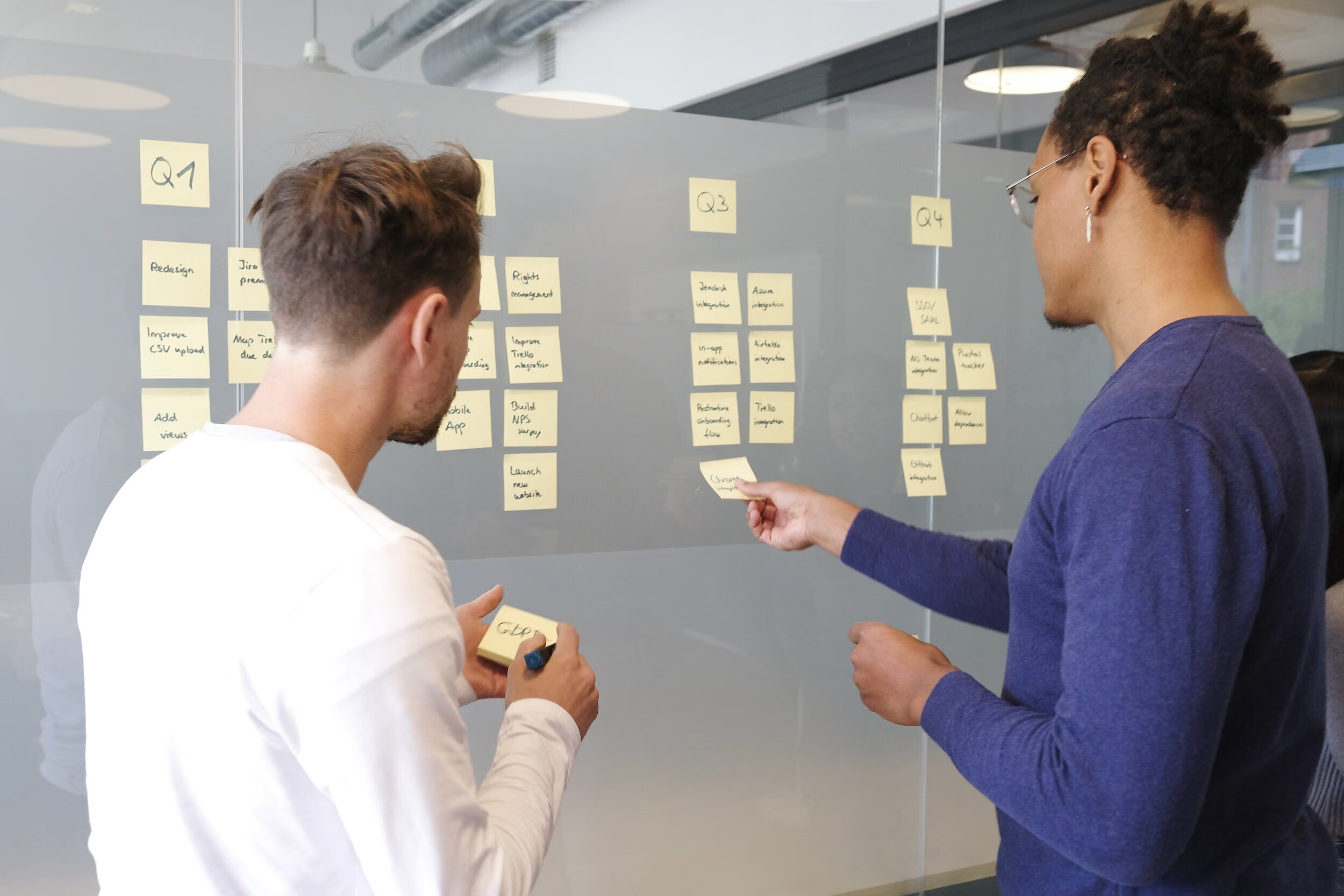
Instead of sticking to a rigid plan, planning is done continuously throughout an Agile project. Each project is divided into small “iterations” or “sprints” that allow the team to micro-focus on value-added deliverables. The team is highly self-directed, managing their own tasks rather than relying on a project or line manager to take on the role of assigning tasks. An Agile PM is more focused on managing projects or sprints according to the methodology and driving organizational alignment. Because team trust is essential, this phase can be where organizations have trouble changing to an Agile environment.
Agile focuses on delivering a usable product as early as possible to solicit stakeholder feedback. Such feedback then becomes the basis of future iterations and improvements. This means that with Agile, products are often delivered in increments or versions, rather than waiting until the product is finished to deliver it to the intended customer. This approach allows for quick enhancements or changes to be easily integrated back into the product, with feedback on early increments informing work on later sprints.
Hybrid
Hybrid project management combines elements of both Waterfall and Agile. The goal of a Hybrid approach is to choose what works from each framework, creating an innovative approach that can meet the needs of a variety of organizations. The challenge with this approach is clarity, as project team members typically are trained in either Waterfall or Agile. Each framework differs so greatly in its approach to change control and management, a hybrid plan on how to manage change is often necessary. To successfully implement a Hybrid project management methodology, total clarity about goals and processes is required.
A common use for a Hybrid approach would be a product that is both software and hardware based. For example, when developing a smart car, a project manager might use Waterfall practices in the overall planning process and execution of the physical car – thinking first about procuring the necessary materials, commissioning appropriate equipment, developing product specifications, before ultimately executing the hardware buildout. The software implementation of the smart car, on the other hand, might be better managed through an Agile approach, running sprints to deliver new versions of the software until it meets the desired quality standards. The PM would take the Hybrid approach to manage both elements of the project simultaneously.
Waterfall, Agile, and Hybrid are all powerful project management approaches; no one methodology is superior to another. Project management consulting can be useful to allow your organization’s project management office to step outside your typical approach to managing projects, and test out new ideas and frameworks. MustardSeed project managers are highly trained in Waterfall, Agile, and Hybrid methodologies and can help guide your organization toward the methodology that serves you best.
The Agile vs. Waterfall debate often gets framed as a tech industry question which is a problem, because most of the organizations that struggle most with methodology selection aren't software companies. They're manufacturers, biotech firms, and regulated businesses where projects look nothing like a product sprint.
In life sciences, pure Agile approaches often create compliance friction. Regulatory submissions, validation protocols, and GMP documentation require traceable, sequential approvals — processes that don't adapt easily to iterative sprint cycles. Waterfall, however, can become dangerously rigid when clinical trial data comes back differently than expected, or when an FDA reviewer requests changes mid-process. This is precisely why hybrid approaches have become the standard in well-run life sciences PMOs: Agile for discovery, research, and cross-functional collaboration phases; Waterfall for validation, documentation, and regulatory submission phases.
In food & beverage manufacturing, stage-gate project management is the dominant framework and for good reason. It combines the structured phase reviews of Waterfall (each gate is a formal go/no-go decision) with the flexibility to iterate within each stage as formulation, packaging, and production testing evolves. Understanding how stage-gate maps to Agile and Waterfall principles helps operations and R&D teams speak the same language and avoid the costly restarts that happen when project methodology and organizational culture are misaligned.
The most effective project managers don't pick one methodology and defend it — they match the approach to the project type, the regulatory environment, the team's maturity, and the tolerance for ambiguity. If you're unsure which approach fits your current program, that's often the first sign you'd benefit from an outside perspective.
Is Agile or Waterfall better for project management?
Neither is universally better. Agile works well for projects with evolving requirements and iterative deliverables. Waterfall is better for projects with fixed scope, sequential dependencies, and formal approvals — such as construction, regulatory submissions, or capital projects. Most complex programs benefit from a hybrid approach.
What is a hybrid project management approach?
A hybrid approach combines elements of Agile and Waterfall. For example, a team might use Agile sprints for early research and design phases, then transition to Waterfall-style phased execution for manufacturing, validation, or compliance-required documentation phases.
Can Agile be used in regulated industries like life sciences?
Yes, but with modifications. Agile principles can be applied in early-stage discovery, cross-functional alignment, and product development phases. However, regulatory submission, validation, and GMP-required documentation phases typically require the sequential controls of Waterfall. Hybrid models are most common in biotech and pharma.
What is stage-gate project management?
Stage-gate is a project management framework where the work is divided into stages (phases of execution) separated by gates (formal review and approval checkpoints). It is widely used in food & beverage product development and pharmaceutical R&D because it ensures structured decision-making before committing resources to the next phase.
How do I know which project management methodology is right for my team?
Consider four factors: (1) How well-defined is the scope? (2) How much does regulatory or compliance documentation constrain sequencing? (3) How experienced is the team with iterative vs. sequential execution? (4) What does your organization's culture reward flexibility or predictability? A PMO consultant can assess these and recommend the right fit.
Source: https://www.pmi.org/-/media/pmi/documents/public/pdf/learning/thought-leadership/pulse/pulse-of-the-profession-2018.pdf