

A clinical-stage biotech developing a novel drug-delivery platform was managing a complex, cross-functional development program across clinical, pre-clinical, CMC, and manufacturing.
As the program advanced, the existing approach to planning could no longer keep pace. Program status was spread across manually updated PowerPoint dashboards, disconnected Gantt charts, and function-specific Excel trackers. Dependencies were difficult to see, schedule changes did not consistently reach the right stakeholders, and there was no single, reliable critical path connecting work across functions.
MustardSeed embedded with the organization to establish the planning discipline, schedule architecture, and operating cadence needed to manage the work as one integrated program. The engagement began with a single development program and ultimately expanded to support portfolio-level visibility across multiple concurrent programs.
Along the way, the organization:
The engagement was subsequently renewed with expanded scope, moving from schedule management for a single program to broader portfolio-level visibility.
Drug-device development creates a dense network of dependencies: a shift in manufacturing can affect clinical readiness; equipment timing can change downstream milestones; regulatory decisions can alter work across multiple functions.
The organization had many of the pieces needed to manage this work, but they were not connected. Program information lived across:
Updates had to be reconciled manually, and dependencies between functions often relied on individuals knowing who needed what information and when.
The result was a fundamental execution challenge: leadership and functional leads did not have one reliable view of what had to happen next, what was driving the critical path, and how a change in one area affected the rest of the program.
As the organization added pipeline programs and other major initiatives, that challenge became increasingly important to solve.
The first several weeks were spent observing the organization's existing operating cadence and interviewing and observing stakeholders across clinical, CMC, and manufacturing to understand how work was actually being managed. From there, MustardSeed and the client established a more integrated approach to program execution.
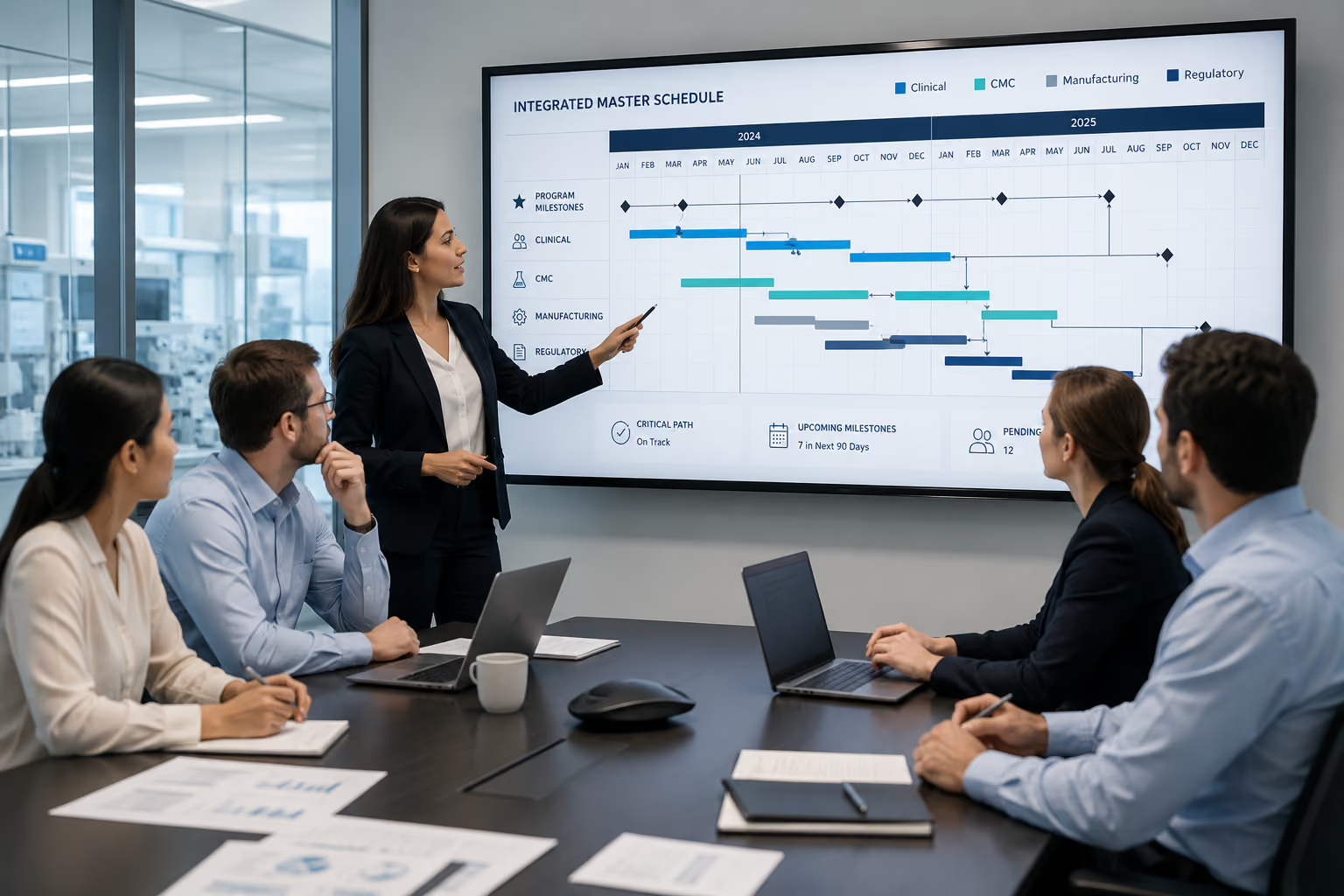
Rather than forcing every function into a single monolithic plan, MustardSeed built an Integrated Master Schedule using a hub-and-spoke architecture. The IMS provided one program-level source of truth, while functional sub-schedules allowed each area to manage the level of detail required for its work.
Together, they created visibility into:
For the first time, individual functions could more readily see how changes within their work affected the broader development program.
The new structure also automated work that had previously required significant manual coordination. Dashboards, milestone tracking, and dependency visibility replaced hand-updated, text-dense presentation slides and disconnected status reporting.
The objective was to give leadership and functional leads a reliable view of the program so they could identify issues earlier and make decisions against the same information.
As the organization grew from one primary program to multiple concurrent development efforts and a facility buildout, another issue surfaced. The same updates were being repeated across several meetings each week, while some critical schedule and equipment information was still not reaching the people who needed it.
Adding more meetings would not solve the problem. The organization needed a better way to move information through the business.
MustardSeed worked with functional leadership to redesign the weekly cadence around how decisions and information actually needed to flow.
The new structure established:
The gain wasn't fewer meetings. It was fixing what was happening inside them: replacing duplicated, informal status-sharing with a standardized weekly format where every function reports against the same structure, within a strict timebox, with clear ownership of what happens next.
A parking lot was established for issues requiring deeper discussion, keeping the core meeting focused while ensuring those issues still had a path to resolution. Importantly, the structure was not imposed as a fixed methodology. The proposed cadence was pressure-tested with functional leadership, revised based on feedback, and formally adopted.
One of the more skeptical functions ultimately became one of its strongest adopters after seeing how the structure addressed problems it had been experiencing firsthand.
The IMS created a shared view of program milestones and dependencies across clinical, CMC, manufacturing, and other functions. When timelines changed, stakeholders could better understand the downstream implications rather than evaluating changes within individual functional plans.
It also gave the team a live view of where float remained in the schedule, so a function could evaluate in real time, often right in the working session itself, whether and by how much an activity could slip or be de-prioritized before that change reached the critical path.
The redesigned operating cadence addressed a recurring problem: important schedule and equipment-timing information reaching the wrong audience, or not reaching the necessary stakeholders at all. The new structure created defined forums for information to surface, decisions to be made, and cross-functional impacts to be addressed.
The engagement also established a formal RAID log and centralized pending and finalized decisions in an executive dashboard, giving leadership one place to see what was decided, what remained open, and what was blocking progress. Embedding program management as a standing function meant those decisions were structurally guaranteed to surface every week through the revised meeting cadence, rather than depending on any one person remembering to loop in the right stakeholder.
The schedule architecture originally developed for the lead program became a reusable model for additional pipeline programs as they entered active development. This allowed the organization to build on an established planning structure rather than creating a new approach for each program.
As the portfolio grew, three concurrent development programs were unified under a single portfolio view, with 8 functional schedules feeding into 3 IMS hubs. The combined cross-program critical path tracks roughly 45 to 50 milestones across approximately 9 functional workstreams.
Bringing all three programs into a shared portfolio view gave leadership the ability to make trade-off decisions and run scenario planning against resources shared across the pipeline, rather than evaluating each program's resourcing in isolation.
Over the course of the engagement, the operating environment became substantially more complex, including:
Despite that increase in complexity, the organization maintained a coherent, trusted critical path across the work.
That claim is borne out in the schedule itself. Through structured weekly schedule deep-dives with the team from kickoff in January 2026 through the end of May, the program's Phase 2 data readout milestone moved up by nearly a year, from an October 2029 date the board had flagged as unacceptable, to November 2028. That schedule was formally baselined in May 2026 and held with zero critical path slippage across the following 90 days.
A separate strategic pivot to a previously unconsidered production line bought the program three months of schedule float on what had been its single highest-risk, critical-path item. The strategic idea came from the technical team; the schedule dependency analysis and feasibility validation that made it executable with confidence was MustardSeed's contribution.
The engagement was renewed and expanded from managing the schedule for a single program to providing visibility across multiple concurrent development programs. The expansion reflected a broader role for integrated program management as the organization's portfolio matured.
When the engagement began, program management was not an established function within the organization. Part of the work was defining what a healthy PM function actually does, and demonstrating it in practice rather than prescribing it from the outside.
The objective was never simply to implement an IMS or improve meetings. It was to establish PM as an integrated function in the organization and develop a repeatable way of managing complex development work.
That meant introducing new practices alongside the change management and stakeholder education needed for them to take hold, clarifying with leadership what the PM function was, and just as importantly, what it was not, before those expectations were communicated to the broader team. Executive buy-in was solicited first, so that when new operating norms reached the wider organization, they arrived with leadership backing rather than as an outside framework layered on top of existing work.
MustardSeed worked alongside the organization to build planning and communication structures around how its functions actually operated, adjusting the approach as the portfolio evolved.
The resulting infrastructure is designed to be sustainable by the organization itself rather than dependent on MustardSeed remaining in the room.

For emerging biotech organizations, adding programs increases more than workload. It multiplies dependencies across clinical, CMC, manufacturing, regulatory, facilities, vendors, and leadership. Managing that complexity requires more than a collection of project plans.
By establishing a shared critical path, connecting functional schedules, automating program visibility, and creating a more disciplined operating cadence, this organization built an execution model capable of scaling with its portfolio.
What began as embedded program management for one development program grew into a broader infrastructure for managing multiple programs with greater visibility, coordination, and control.
We respect the privacy of the organizations that trust us to embed within their teams. For that reason, we do not publicly disclose client names or partner names in our case studies. If you would like to verify our impact and speak directly with a reference, we are happy to facilitate introductions.


%20Reporting.avif)